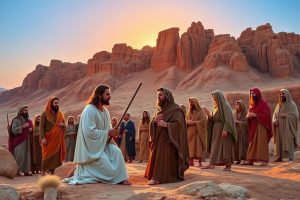
Women as the Hidden Force of Redemption

Women as the Hidden Force of Redemption

of Ulpan-Or, the International Center
for Hebrew and Israeli Culture Studies.
Hebrew at the Speed of Light!
You’re invited to a personalized conversation with Ulpan-Or’s founders—an opportunity to map out the Hebrew journey that fits you best.
Secure your place on Zoom HERE
Torah portion Sh’mot opens the book of Exodus and introduces redemption in a deeply unexpected way.
It does not begin with miracles, plagues, or prophetic declarations. Instead, it opens with a series of quiet human choices — choices made almost entirely by women, choices rooted not in power but in conscience.
Before Moses steps onto the stage of history, before Pharaoh is confronted, before God’s name is revealed, there are women who refuse to accept the moral logic of their time. They do not overthrow the system; they undermine it simply by choosing life.
Moral courage in a world of obedience.
Shifra and Puah are commanded by the most powerful ruler of their age to participate in a program of systematic killing.
The Torah tells us that they “feared God,” but this fear is not expressed through ritual or proclamation. It is expressed through refusal.
They do not challenge Pharaoh openly. They do not argue ideology. They simply do not comply.
In a culture that rewards obedience and punishes conscience, they introduce a dangerous alternative: moral responsibility. Rabbinic tradition identifies these midwives as Yocheved and Miriam, mother and daughter.
Redemption, it turns out, does not begin with armies or speeches, but with ethical courage transmitted quietly from one generation to the next.
Yocheved: faith without the illusion of control
Yocheved gives birth at a moment when birth itself has become an act of resistance.
For three months she hides her child, protecting him as best she can. When concealment is no longer possible, she faces an impossible choice — and responds with an act of profound faith.
“She took for him an ark of reeds.”
This is not abandonment. It is trust without certainty. The small ark she prepares is not an escape, but a vessel of transition — an act of hope in a world that offers no guarantees.
Yocheved teaches that faith does not always mean holding on; sometimes it means releasing without despair.
Miriam: the strength of staying present
Miriam, still a young girl, stands at a distance and watches the ark among the reeds. She cannot intervene. She does not know how the story will end. Yet she remains.
There are moments when redemption demands decisive action, and moments when it demands presence — the courage to stay, to witness, and to refuse to turn away. Miriam’s quiet vigilance reminds us that remaining emotionally present in uncertainty is itself a form of faith.

Bat Pharaoh: compassion that breaks boundaries
Perhaps the most startling figure in the story is the daughter of Pharaoh – Bitya.
She is fully embedded in the world of power that has decreed death, yet when she encounters the crying child, she responds not as a ruler’s daughter but as a human being.
“She had compassion on him.”

Before identity, before politics, before loyalty to empire, there is compassion. The Torah offers no explanation — only the act itself. The future redeemer of Israel survives because a woman inside the palace refuses to silence her moral instinct.
A Chassidic story: quiet persistence
A Chassidic story tells of a Jewish woman whose husband was imprisoned unjustly by local authorities. Friends advised her to remain silent, warning that persistence would only bring trouble. She chose another path.
Each day she came to the prison gates with food — sometimes for her husband, sometimes for others. She spoke respectfully to guards who ignored her. She did not shout or threaten. She simply refused to disappear.
Weeks later, an official finally asked, “Who is this woman who returns every day?” Not long afterward, her husband was released.
When people praised her courage, she replied, “I did not come to fight power. I came to remind the world that compassion still exists.”
A psychological lens: moral courage
Modern psychology refers to this capacity as moral courage — the ability to act according to deeply held values despite risk, social pressure, or uncertainty.
Psychologist Rushworth Kidder, founder of the Institute for Global Ethics, defined moral courage as the willingness to stand up for ethical principles when doing so carries a personal cost. He emphasized that such courage usually appears not in heroic spectacle, but in quiet, uncelebrated decisions.
Social psychologist Philip Zimbardo similarly argued that resisting immoral systems does not require extraordinary personalities. His work on everyday heroism highlights how ordinary individuals can choose responsibility even within environments that promote obedience and moral numbness.
None of the women in the opening chapters of Exodus could foresee the consequences of their actions.
They were not trying to shape history.
They were responding to an immediate moral demand: to protect life and to remain human.

Hebrew corner: words that give life
· וַתְּחַיֶּיןָ (va-techayena) — not merely “they did not kill,” but they actively sustained life
· חֶמְלָה (chemlah) — compassion that moves one to act
- מָלֵא חֶמְלָה – full of compassion
· מְיַלֶּדֶת (meyaledet) — one who brings life into the world, physically and spiritually
· תֵּבָה (teyvah) — (box, word), a vessel of passage; not a destination, but a means of survival and hope
- תֵּיבַת דּוֹאַר – (Teyvat do’ar) – Mailbox
- תֵּיבַת הִילּוּכִים – (Teyvat hilukhím) – Gearbox
- רָאשֵׁי תֵּבוֹת – (Rashey Teyvot, lit. heads of words) – Acronym
- תֵּיבַת פַּנְדּוֹרָה – (Teyvat Pandóra ) – Pandora’s box

Here and now
In times of exhaustion, division, and moral confusion — in Israel and throughout the Jewish world — this Torah portion offers a quiet but demanding message. Redemption does not always begin with certainty or strength.
Often, it begins with individuals who refuse indifference, who choose compassion over despair, and who quietly insist on preserving life.
The women at the beginning of Exodus remind us that history is shaped not only by those who hold power, but by those who remain human when humanity itself is under threat.
Shabbat Shalom,
Yoel & Orly
You may also like

Adar: The Month Everything Flips
From Sinai’s Fire to the Architecture of a Just Society